Patrice Ponza’s inland trek along the Via Alpina
It is often thought that adventure begins far away – at the edge of a wonderful world. In reality, it begins quite simply, in a moment that is often silent: the moment when you decide to take a chance. To dare to leave the familiar path, take a step to the side, then another, and listen to that inner voice whispering that life is too short not to try something new.
The Via Alpina turns out to be one of Europe’s most challenging hiking trails. This high-altitude route crosses a stretch of the continent. This chain of ridges and valleys links the Slovenian Alps to the Mediterranean. It is this mountainous thread that I have chosen to follow, on foot, just as one follows an intuition. Day after day, step by step, far from familiar landmarks, on a slow journey of self-discovery.
On these steep paths, time seems to stretch out. The body adapts, the mind refocuses, emotions lighten. Each mountain pass crossed becomes a new inner milestone. Here, the destination is not so much a place as a state of being. Of course, there are the landscapes: the raw, rocky terrain of the high altitudes, the light-drenched mountain pastures, the starry nights far from everything. There are also the encounters – brief but intense – woven around a high-altitude campsite. But the essence lies elsewhere, in that intimate dialogue with oneself that a long-distance trek allows. Because reclaiming the right to simply be requires daring; the only true failure would have been not to try. To remain still in the face of the call to set off, the need to walk.
Perhaps my adventure boils down to this: having dared to venture elsewhere. By humbly accepting the effort, the doubt, and the simple joy of living. The Alps are thus a ‘celebration’ of wonder.
………………………………………………………………………………
Three months following the unobtrusive trail of the Via Alpina. Two thousand kilometres on foot between the Adriatic and the Mediterranean, with a cumulative elevation gain of over 120,000 metres. On the map, it looks like a whimsical line linking eight countries. On the ground, it is an endless succession of ascents, descents, jagged ridges and deep valleys. An arc of stone and light stretching across Europe. But beyond the geography, there was another journey: walking through my inner Alps.
On the summer solstice, the dawn was the colour of salt. In Piazza Marconi, in Muggia, the Adriatic Sea still held the night within its inky folds. The air was still, edged with a pale light. I tightened my laces, hoisted my seventeen kilos of essentials onto my shoulders, then turned my back on the liquid horizon as one closes a book one has already read. Before me, the first limestone undulations of the Julian Alps sketched out a promise.
The first few days were sweltering. In late June, the heat rose from the white stones of Slovenia like heavy breathing. The paths wound their way through the beech forests; the air buzzed with bees and the scent of heated resin. Then, almost suddenly, the mountain changed its face.
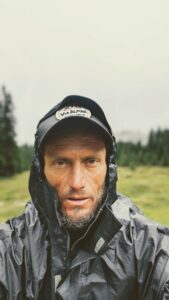
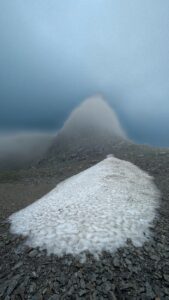
In early July, clouds settled over the Carnic Alps like a persistent presence. Rain flooded the valleys, whilst snow blanketed the higher ground. In South Tyrol and then in Austria, the mountain passes vanished into thick fog. The wind lashed the ridges, and the temperature plummeted. Walking became a relentless battle against the elements: in my shoes, in my clothes, even in my spirits – the sky seemed to be clawing at me.
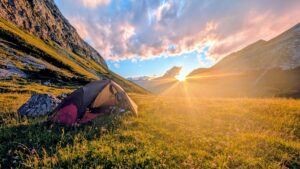
Some mornings, the tent was stiff with hoarfrost. My rucksack seemed heavier than the day before. The urge to give up would sometimes surface during the long, silent climbs. It would walk a few kilometres by my side before drifting away.
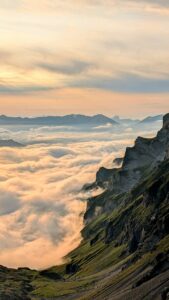
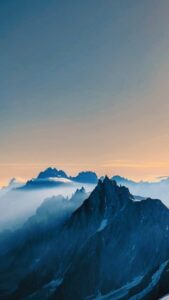
In these majestic Alps, when everything seems to waver, wonder becomes a compass. It barely whispers, but it persists. A sudden break in the clouds over a glacier, the slow breathing of a valley still asleep, the steady sound of a torrent beneath a wooden bridge. Beauty often springs from these tiny details. It slips beneath the exhaustion and rekindles an inner ember.
Little by little, walking becomes a bridge between body and mind. A tenuous link that connects us to the movement of living things.
Fatigue, for its part, establishes its own language. After weeks of walking, the body falls into a strange rhythm. The steps follow one another, breathing adjusts to the slope, and the mind detaches itself from the everyday hustle and bustle. The days become simple cycles: walking, drinking, eating, sleeping. And starting again.
Repetition wears down inner resistance. It smooths out emotions just as water smooths stone. Certainties crack, worries lose their weight. There is no spectacular revelation, only a slow transformation. A transformation born of exhaustion, but also of a strange peace that settles in when the body finally agrees to slow down.
In the height of summer, in the district of Schwaz, I met Thomas. A young photographer who was also walking alone along the Via Alpina. We shared a few days on trails suspended between earth and sky.
Thomas possessed a rare sensitivity. Our silences were sometimes more profound than our words. In the evening, gathered round the stove or gazing at the ridges bathed in the rosy glow of the setting sun, we spoke of solitude, writing, photography, creativity, and those emotions that walking brings to the surface when it strips away everything else.
These conversations had the simplicity of the essential things. Then, as is often the case in the mountains, our paths parted without any particular ceremony. Ridge lines divide in just this way: gently, without a break. Some encounters do not need to last long to bring about change.
The alpine landscapes followed one another like the chapters of a vast book. The rugged authenticity of South Tyrol, with its flower-bedecked farmhouses clinging to the slopes. The wild terrain of the Karwendel, where limestone cliffs plunge into deep forests. The austere, silent peaks of Bavaria that inspire wanderlust. The more secluded valleys of Liechtenstein, with their Alemannic character.
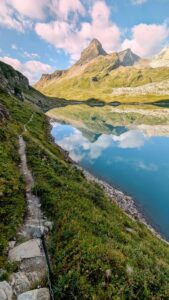
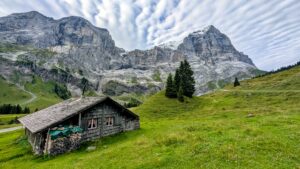
When I reached Switzerland, the sky cleared once more. After weeks of rain and mist, the light returned with unexpected intensity. The glaciers of the Oberland finally came into view, suspended above the valleys like fragments of frozen time. My spirits lifted too.
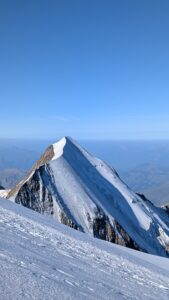
The mountains have never inspired me to take on a challenge or achieve a feat. If they draw me in, it is because they were my birthplace. Yet, on 18 August, an unforgettable moment took place on this Via Alpina: I set out to conquer Mont Blanc. Because crossing the Alps without setting foot on its summit would have left me feeling as though the journey were incomplete.
The ascent was technical, slow and fraught with doubt. In the thin air, every step demanded absolute concentration. My breath grew short; the slope seemed endless. Then suddenly, there was nothing above me.
At the summit, the light was of an almost unreal purity. The horizon stretched out in every direction, a sea of peaks and glaciers frozen against the azure sky. There, I felt the weight of the journey I had undertaken. Every valley crossed, every doubt overcome, seemed to converge on that suspended moment.
Solitude, on this long walk, was never a loss. It gradually transformed into a presence. Walking alone for months creates a unique inner space. Thoughts settle like dust after the wind. Emotions become clearer. Solitude ceases to be a void and becomes a form of listening.
In this inner exile, I fell silent to better perceive what whispers within and to feel the outside world when the sky grows still. In this silent movement, walking becomes a way of inhabiting the world differently.
The Alps, too, change as the kilometres pass.
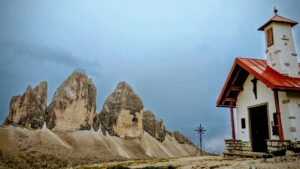
From Triglav to the Karnischer Höhenweg, from the Dolomites to the Jungfrau, from the Vanoise to Piedmont, certain landscapes are among the most iconic on the planet. Famous trails are filled with curious onlookers. Decisions on where to stop are sometimes influenced by a view that has gone viral. The hiker’s profile is changing: enthusiastic, connected, eager to share the moment.
Yet behind all this hustle and bustle lies a deeper desire: to rediscover a simple connection with the mountains. A place where one can still walk for hours on end, far from the noise, taking time to appreciate nature.
With the arrival of autumn, the sienna hues burst forth. As I made my way south, the landscape grew more arid. The Alpine valleys had an almost meditative austerity. The air itself had changed. A scent of heated rock and dry earth already heralded the sea.
One morning, from the Fort de la Tête-de-Chien, the Mediterranean came into view.
In Monaco, it glistened like a distant echo of the Adriatic from which I had set out. I realised then that the journey had never been about connecting two shores. It unfolded in the space between them.
Three months to learn to slow down. Three months to listen, to feel, to touch. Three months to discover that the mountains cannot be conquered: they barely allow themselves to be walked through, step by step.
………………………………………………………………………………
It was whilst walking the Alpine arc that “VIA ALPINA – Mes Alpes intérieures” (“My Inner Alps”) came into being. This book, published by La Trace, is as much a photographic journey as it is a narrative embodied by adventure.
Within these pages lie fragments of light, wind and sky. The reader experiences the mountains as one truly does when living amongst them: setting off at dawn, a rucksack already heavy before the first step has even been taken, mountain passes where the wind tears at the soul, and unmanned mountain huts where a silence more precious than words is shared. In this account, there is the fatigue that gnaws at the body, the exhaustion that strips away certainties, and sometimes a precious glimmer of light.
VIA ALPINA – Mes Alpes intérieures does not seek to recount feats of endurance. It attempts to convey what walking does to time, to thought, to one’s perspective. When the days merge into one another, when the world is reduced to a single path. When every step becomes an intimate unit of measurement. You move forward, and something within you lightens. The photographs were born out of this very same movement. They do not guide; they extend the walk.
You enter this story as you set out into the mountains: without certainty, slowly, ready to let yourself be carried along.
https://www.instagram.com/patrice.ponza?igsh=MWxpazk0cW40ZjNxZA==